Coloring Pages in the Classroom: A Practical Guide for Teachers
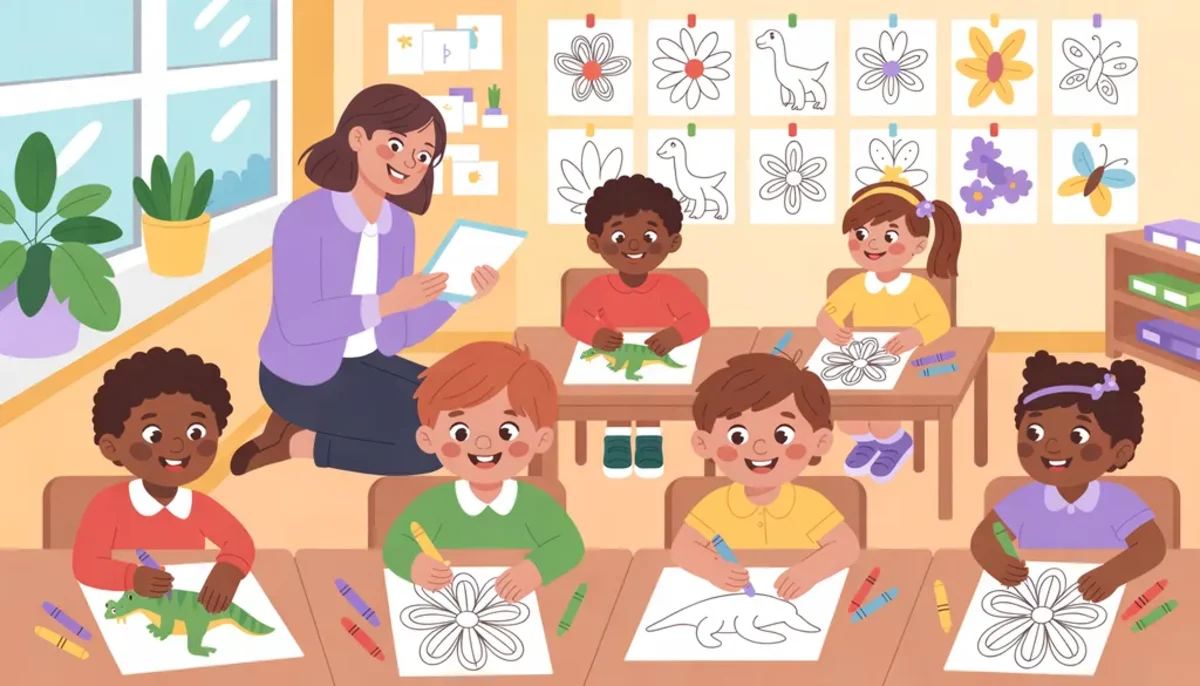
Coloring pages are one of the simplest tools a teacher can keep in a drawer. They calm a busy room, give early finishers something useful to do, and can be linked to almost any topic, from seasons and holidays to dinosaurs and plants. This guide shows practical ways to use coloring pages in class, how to pick the right level for each grade, and how to print a full class set without wasting paper or ink. Every page on CuteColorings is a free PDF that you may print for your classroom, with no sign-up.
Quick answer: Use coloring pages for morning work, early finishers, a calm corner and short brain breaks, and connect them to your current topic. Pick very bold, simple pages for preschool and kindergarten, small scenes for grades 1–2 and detailed or pattern pages for grades 3–5 and older. Print in black and white on A4 or US Letter with “Fit to page”, and our free pages may be copied for your own class.
Why use coloring pages in class?
Coloring is not just a time filler. A good page gives children a quiet, low-pressure task with a clear finish line, and it gives teachers a few calm minutes to work with small groups. Teachers commonly use coloring to:
- Practice fine motor control: holding a crayon and staying near a line builds the hand control that later helps with writing.
- Settle the room: a familiar, quiet activity after recess or before a test helps many children calm down.
- Talk about a topic: a picture of a T-Rex skeleton or a butterfly is an easy way to start a conversation and new vocabulary.
- Follow instructions: “color the big flower red and the small one yellow” turns a page into a listening task.
- Make classroom decorations: finished pages become seasonal displays, bulletin boards and cards.
Every class is different, so treat these as ideas to try rather than promises. What works best depends on your students and your routines.
7 ways to use coloring pages in the classroom
1. Morning work and quiet arrival
Place a page on each desk before students arrive. Children who come in early have something calm to do, and you have time for attendance and notes from parents.
2. Early finishers
Keep a labeled folder of pages at different levels. Students who finish early pick one quietly, which avoids the “I’m done, what now?” moment.
3. Calm corner and brain breaks
A few simple pages and a box of crayons in a calm corner give upset or overexcited students a way to reset. A five-minute coloring break between lessons can also help a restless class refocus.
4. Linking coloring to a topic
Choose pages that match what you are teaching and add one small task, such as labeling, counting or writing a sentence under the picture.
🖍️ Try these: T-Rex coloring pages (with a fossil dig and a skeleton study) for a dinosaur unit, butterfly coloring pages and flower coloring pages for plants and life cycles, and snowman coloring pages for winter and weather.
5. Seasons and holidays
Seasonal pages are a simple way to mark the school year: harvest and Thanksgiving in autumn, snow and winter holidays in December, hearts in February and flowers in spring.
🖍️ Try these: Thanksgiving coloring pages, turkey coloring pages, Christmas coloring pages and Valentine coloring pages.
6. Listening and following directions
Read out simple instructions one at a time: “Color the T-Rex green. Draw a sun in the corner. Color three leaves yellow.” Younger students practice listening, colors and numbers; older students can follow longer, two-step directions.
7. Rewards and class displays
A favorite page can be a small reward on Friday afternoon. Finished pages make a cheerful display wall, and children love to see their work hanging in the hallway.
Choosing the right level for each grade
Children of the same age can be at very different stages, so offer two levels when you can. Our coloring pages by age guide goes into more detail. As a quick classroom rule of thumb:
| Grade | What usually works | Good picks |
|---|---|---|
| Preschool and kindergarten | One big object, very thick lines, no background | Easy pages at the top of our collections: cupcakes, bunnies, snowmen, baby T-Rex |
| Grades 1–2 | One or two characters in a small scene | Holiday scenes, farm and ocean animals, dinosaur adventures |
| Grades 3–5 | More detail, realistic animals, patterns inside shapes | Realistic animals, fossil and museum scenes, flower gardens |
| Grades 6 and up | Fine lines and many small areas | Mandalas, zentangle, stained glass and full-page patterns |
Most of our collections are sorted into easy, kids and detailed sections, so you can print several levels of the same theme and every student works on the same topic.
Printing a class set without wasting paper or ink
- Paper size: our PDFs are A4 portrait and also print well on US Letter if you choose “Fit to page”.
- Black and white: print in grayscale to save colored ink; the pages are pure black lines on white.
- Check one copy first: print a single page and check the size before printing thirty.
- Thicker paper for displays: 120–160 gsm paper stops markers from bleeding through and holds up on a wall.
- Keep a master folder: store one clean copy of each favorite page so you can photocopy it again next year.
Making coloring work for every student
- Offer a choice: let students choose between two levels of the same picture, so nobody feels left out.
- Bold pages help many learners: students with motor difficulties often find thick outlines and big spaces easier and less frustrating.
- Mix the tools: chunky crayons, pencil grips, washable markers and colored pencils all suit different hands.
- Don’t grade neatness: for most activities, effort and enjoyment matter more than staying inside the lines.
- Allow a quiet alternative: some students may prefer drawing their own picture; that is fine too.
Classroom use and copyright
You may print our coloring pages for your own class, school activities, libraries and community events. Please do not sell them or upload them to other websites. The full rules are in our terms and conditions, and you can read how we make and check our pages on our quality and kids safety page.
Frequently asked questions
Can I print CuteColorings pages for my whole class?
Yes. You may print as many copies as you need for your own classroom and school activities. Please do not sell the pages or share them on other websites.
Do the pages work on US Letter paper?
Yes. The PDFs are made in A4 portrait size and print well on US Letter when you choose “Fit to page” in your print settings.
How long should a classroom coloring activity last?
Many teachers use short sessions of about 5 to 15 minutes, for example as morning work or a brain break. Adjust the time to your students and the task.
What coloring pages are best for kindergarten?
Choose pages with one big object, very thick lines and no background, such as the easy pages at the top of our cupcake, bunny, snowman and T-Rex collections.
Can older students use coloring pages too?
Yes. Grades 3 and up often enjoy detailed animals, mandalas, zentangle and stained-glass style pages, which take longer and need more care.